christmas
Office Christmas Card Ideas: 15 Tasteful Designs to Send the Whole Team
Published 28 October 2026
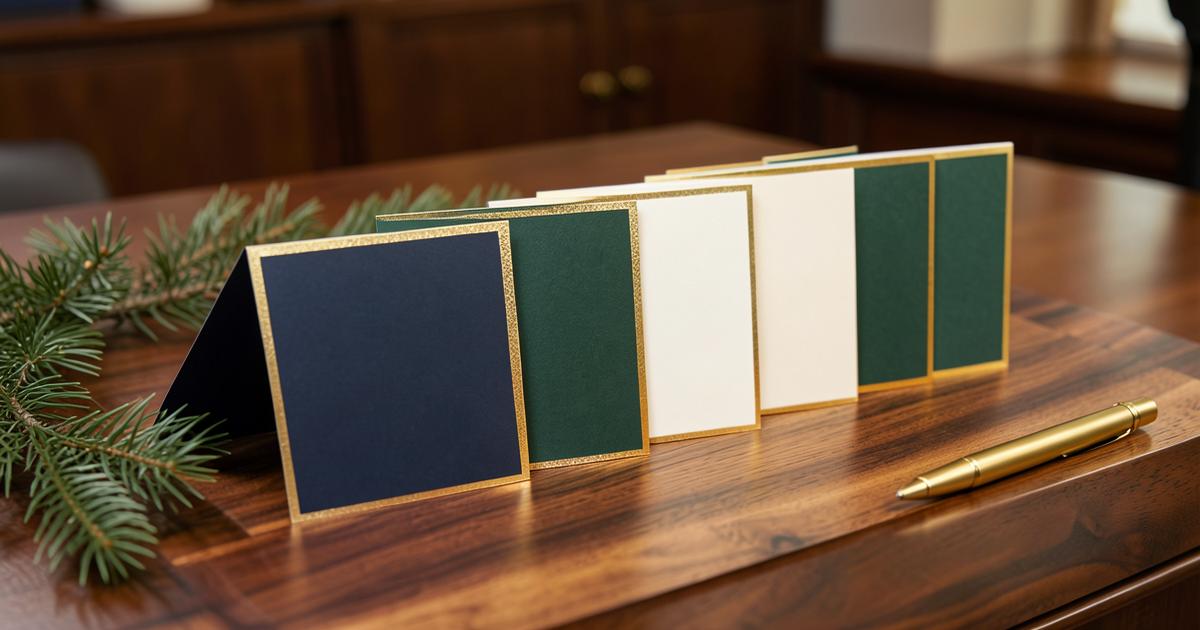
Office Christmas cards are a small genre, often overlooked, and disproportionately effective when done well. The right card warms a client relationship for a year. The wrong one looks like spam. This guide is fifteen office Christmas card ideas — tasteful paper designs, branded digital formats, and team-wide options — that work for the inner client circle, the wider contact list, and the team itself.
Why office Christmas cards need to balance warmth and restraint
The audience is mixed-faith, mixed-tone and reading the card in a work context. The card has to land warmly without being intimate, professionally without being cold, and tastefully without being generic. Branding helps continuity. Restraint helps it land as a gesture rather than a marketing piece.
15 office Christmas card ideas for 2026
1. A branded paper card with a hand-signed inner message
The classic. A tasteful printed card with the company brand subtly applied, signed by leadership in actual pen. Strongest for the inner client circle (top twenty to fifty contacts).
2. A branded digital musical greeting card from leadership
A musical greeting card with the brand palette applied, photos from the year, a short message from leadership, and a Christmas backing track. Sent by link to the wider contact list. Scales gracefully.
3. A "year in pictures" digital card
Twelve to twenty photos from the year — events, milestones, team moments — set to a Christmas track. Doubles as a year-in-review and a Christmas card simultaneously.
4. A team-signed photo card
A printed photo of the whole team with handwritten signatures around the edges. Particularly strong for long-standing client relationships where the team is known by name.
5. A charity-donation card
"In lieu of paper cards this year, we have donated to [charity]." Tasteful, on-brand for ESG-conscious companies, and removes the paper-card production cost.
6. A custom-illustrated Christmas card
Commission a small illustration from an Australian artist that reflects something about the company — the office, the team, the year. Costs more per card but lands as a keepsake.
7. A digital card with leadership voice messages
A musical greeting card where the leadership team records short voice messages — 10 seconds each, thanking clients for the year. Personal at scale.
8. A team-recorded video greeting
A 60-second video of the whole team waving and saying merry Christmas, set to music underneath. Energising and human, particularly for clients who do not see the team often.
9. A tier-personalised card list
Three versions of the card — top clients (paper plus digital), mid-tier (digital with a personal line), wider list (digital, generic). All three from the same template, with the personal layer dialled to match the relationship.
10. A "thank you for [specific project]" card
For top clients, a printed or digital card that specifically acknowledges a project from the year. Generic gratitude is weaker than specific gratitude.
11. A digital card with the team named
Every team member listed inside the card. Works as both a Christmas card and a soft "here is who we are" reintroduction — particularly useful for clients who only deal with one or two staff members.
12. A printed card with a small artisan gift
A tasteful card paired with a single Australian artisan chocolate or coffee item, shipped to top-tier clients. The card carries the message; the gift carries the warmth.
13. A Christmas card that recaps the company year briefly
A printed or digital card with a tiny "highlights of 2026" section on the inside — three bullet points, not a press release. Adds substance without crossing into sales territory.
14. A handwritten card from the CEO to top clients
Five to fifty cards, handwritten by the CEO. Slow to produce, extraordinarily well-received. Particularly powerful for long-tenured top clients.
15. A Christmas card with a January catch-up offer
A tasteful card that closes with "looking forward to catching up in January" — and then actually books the catch-up in mid-January. The follow-through is the gift.
The dual-format approach most offices now use
The pattern that consistently works: printed paper cards for the inner circle (top tier of clients and partners), branded digital musical cards for everyone else. The two formats together cost less than a full printed mailout, scale further, and land harder. The paper carries the keepsake weight; the digital carries the personal content.
What to avoid in any office Christmas card
- Heavy branding, sales lines, or anything resembling a pitch.
- Religious imagery in mixed-faith client lists — neutral seasonal imagery works better.
- References to next-year contracts or renewals.
- Glitter, foil, or unrecyclable finishes — increasingly poor optics.
- Anything that requires the recipient to click through to a landing page.
- Tone that does not match how the company actually communicates the rest of the year.
How to plan the office card list
- October — agree the format split (paper for tier 1, digital for tier 2+).
- November — design and print paper cards. Hand-write the inner-circle ones over two or three weeks.
- Mid-November — post international paper cards.
- Early December — post domestic paper cards.
- Mid-December — send branded digital musical cards across the wider list.
- Christmas Eve — final digital sends to anyone missed earlier.
The office card checklist
- Does the card reflect the brand without being a sales piece?
- Is the wording neutral enough for mixed-faith and global audiences?
- Is the inner-circle card hand-signed?
- Is there a digital format scaled across the wider list?
- Are the printed cards posted on time?
Closing thought
Office Christmas cards are a quiet, undervalued relationship lever. The right card warms a client relationship for the year. The right combination — paper for the inner circle, branded digital for everyone else — costs less than a full mailout and lands further. Build a digital piece from our musical greeting card creator, and see the formats on our pricing page.
Frequently Asked Questions
What is the best office Christmas card to send?
For internal teams, a digital musical greeting card from leadership with photos from the year and team names lands harder than printed paper cards. For external clients, the strongest approach is a tasteful branded card paired with a digital follow-up that scales across the contact list.
Should office Christmas cards mention Christmas or holidays?
For mixed-faith client lists and global teams, neutral wording — season''s greetings, warm wishes for the holidays, happy holidays — is safer. For domestic Australian audiences in a single-culture setting, Christmas wording is generally fine. Match the wording to the actual audience.
Should office Christmas cards be branded?
Lightly. A subtle logo, a brand colour palette, and consistent typography work well. Avoid heavy branding, calls to action, or anything resembling a sales line — corporate Christmas cards lose their goodwill the moment they feel transactional.
What is a good digital office Christmas card?
A musical greeting card with a short leadership message, photos or footage from the year, the team named, and a Christmas backing track. Sent by link to the contact list, it scales gracefully across hundreds of recipients and arrives instantly in any country.
How early should office Christmas cards go out?
Paper cards to international clients — by mid-November. Domestic paper cards — early December. Digital cards — any time from mid-December through Christmas Eve, with the strongest send window being the week before Christmas.