father's day
Messages From Children to Dad: What to Write This Father's Day
Published 26 June 2026
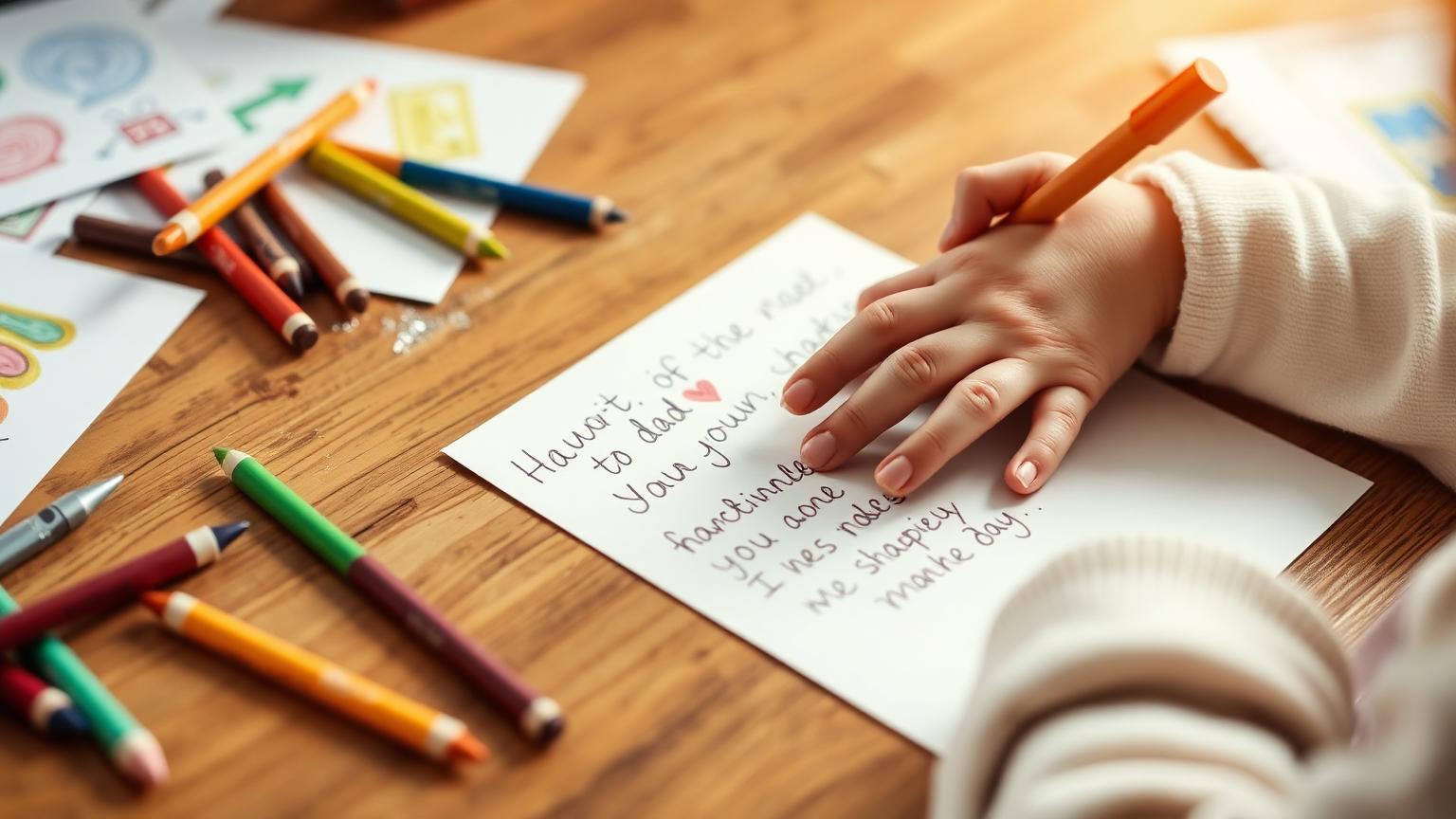
Some of the most moving things a dad ever reads come from his own kids. Whether it's a five-year-old's crayon scrawl or a thirty-five-year-old's carefully chosen paragraph, a Father's Day message from a child carries a weight no greeting-card cliché can match. This guide collects the best messages from children to dad — by age, by tone, and by occasion — so you have something to start from when the page (or screen) is blank.
Why messages from children matter so much
Dads keep these. They screenshot them, save them in drawers, fold them inside wallets. A message in a child's own words — or in your adult voice looking back — is the thing he'll re-read on hard days. Get the message right and the gift around it almost doesn't matter.
From little kids (under 7)
Keep it short, keep it true, let them say it their way.
- "You give the best hugs in the whole world."
- "I love it when you make pancakes."
- "You are my favourite person to play with."
- "Thank you for reading me the same book every night."
- "I love you bigger than the sky."
- "You are the silliest dad and that's why you're the best."
- "When you laugh I laugh too."
For little kids, voice notes often work better than written words. Record them saying it. Pop the voice into a digital Father's Day card and dad replays it for a week.
From older kids and tweens (8–14)
- "Thanks for never missing a single game even when it was raining."
- "You make me feel safe when I'm scared."
- "You're the best at explaining things when I don't get the homework."
- "I know I roll my eyes when you tell jokes but they're actually funny."
- "Thank you for being patient with me."
- "I love how you sing in the car even though you don't know the words."
- "You're the reason I love [football / cooking / fishing / Lego]."
From teenagers
Teen messages work best when they're a little dry, a little honest, and slip in one moment of real warmth.
- "I know I'm not great at saying it, but thanks for everything. Seriously."
- "You've taught me more than you think. Even the stuff I pretend not to listen to."
- "You're the most patient person I know. I don't know how you do it."
- "Sorry for the last 14 years. Love you, Dad."
- "Thanks for showing me what a good man looks like."
From adult children
This is where the long-form message lives. Pick one memory and write into it.
"Dad — I think about the drive home from uni in your old Hilux more than you'd guess. You didn't say much, but you didn't need to. I learned more from those four-hour drives than from any lecture that year. Thanks for being the kind of dad who shows up without making it about himself. Happy Father's Day."
"You always said 'just do the next right thing.' I've said it to myself out loud on the worst days of my life. It always works. Love you, Dad."
"I'm a parent now and I finally get it. The tiredness, the worry, the quiet pride. All of it. Thank you for doing all of it for us, when you must have been just as scared as I am now."
From the whole family
If multiple kids are contributing to one card, give each one a line. The pattern works every time:
- "Dad — thanks for…" (one specific thing per person)
- "We love you for…" (one shared thing as a family)
- "Happy Father's Day."
For step-dads
Name the relationship. Don't be vague.
- "You didn't have to show up the way you have. You did anyway. That means everything."
- "Thanks for treating me like your own. I think of you as my dad. Always have."
- "Family isn't about blood — it's about who's there at every birthday, every school run, every hard week. That's you."
For grandads (from the grandkids)
For more on this specifically, see our guide to gifts for grandad from the grandkids. But for the message itself:
- "You make the best [biscuits / pancakes / Sunday roasts]."
- "I love it when you tell me stories about when Dad was little."
- "You're the only grown-up who actually wants to play."
For dads no longer with us
Father's Day can be heavy. Write to him anyway. Many people send a card to themselves with photos of dad and the message they wish they could deliver — it's a small, private act of remembrance.
"You'd love seeing the kids run around. I tell them about you. I see you in them every day."
How to deliver the message
Write it in a card, record it as a voice note, film a 30-second video, or pair the words with a personalised song. The strongest format is usually a digital card that holds the message, the photos, and the music all in one place.
If you want the message set to music, see our piece on personalised Father's Day songs — a song built around the lines above is something he'll keep forever.
One last tip
Don't edit it five times. Don't try to be a poet. The shortest, truest sentence in your message is the one he'll read again at midnight. Write that one first.
Frequently Asked Questions
What's the best Father's Day message from a young child?
Short and specific is best: 'I love it when you make pancakes' lands harder than 'You're the best dad.' For under-7s, recording them saying it as a voice note is often even better than writing it down.
What should an adult child write in a Father's Day message?
Pick one specific memory and write into it. A single concrete moment ('the drives home from uni in your old ute') outperforms paragraphs of general sentiment every time.
How do I write a message for a step-dad?
Name the relationship directly. Acknowledge that he chose to show up. Specificity ('the school runs, the patience, the showing up') means more than the word 'step-dad' ever will.
Can I include voice messages from the kids in a card?
Yes. Digital Father's Day cards can hold voice notes, video clips, photos and written text together — perfect for capturing little kids in their own voices.
What if I'm not great with words?
Borrow a line from this article and add one specific detail of your own. That's it. The 'specific detail' is the part that makes it yours — everything else just sets it up.