christmas
Eco-Friendly Christmas Cards Australia: A Guide for 2026
Published 26 August 2026
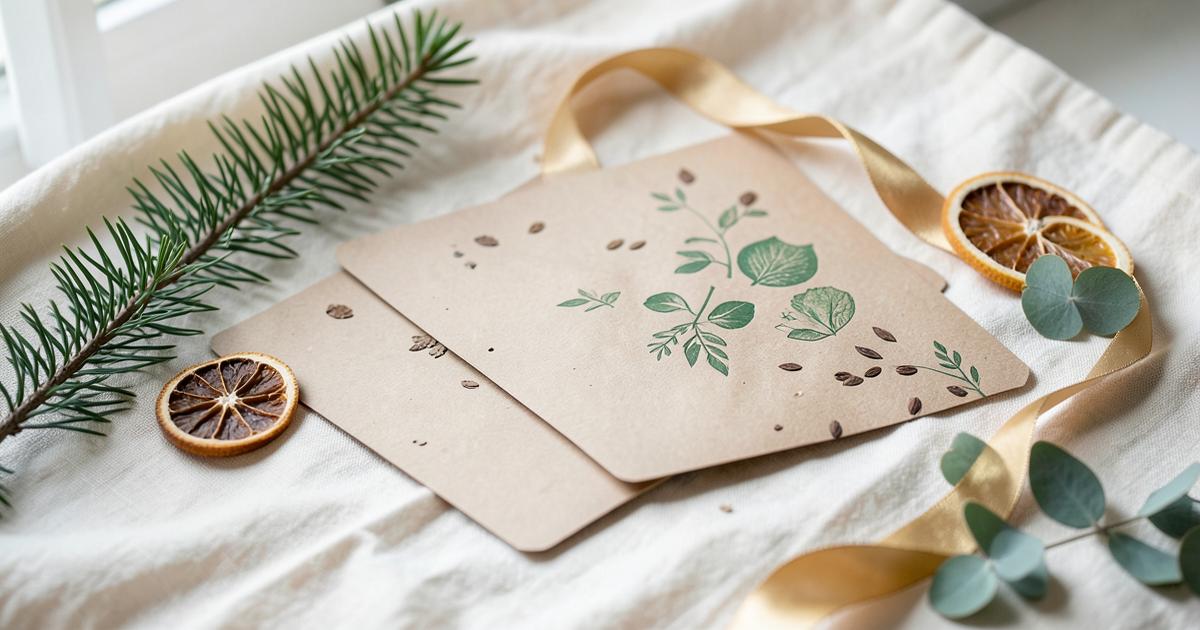
Sending Christmas cards used to be a quietly large environmental event. Hundreds of millions of cards posted across Australia and the world, most of them in plastic-windowed envelopes, many of them coated in glitter or foil and therefore unrecyclable. The 2026 picture is meaningfully better, and Australian households have more eco-friendly options than ever — across both paper and digital. This guide walks through them clearly so you can make a choice that fits your list and your conscience.
What "eco-friendly Christmas card" actually means
Four things determine the environmental footprint of a Christmas card: the material it is made from, the inks printed on it, how far it travelled to reach the recipient, and whether it can be recycled or composted afterwards. A card can be marketed as eco-friendly while failing on two of those four. Knowing what to look for matters more than the front of the packet.
Eco-friendly paper Christmas card options for Australian shoppers
1. Recycled card stock (the simplest upgrade)
Look for at least 70% recycled content, ideally 100% post-consumer waste. Most major Australian stationery brands now offer recycled ranges. The cost is similar to standard cards, the look is often better, and the footprint is meaningfully lower.
2. FSC or PEFC certified card
If new card stock is used, FSC (Forest Stewardship Council) or PEFC certification confirms it came from sustainably managed forests. This is the minimum bar for any non-recycled paper Christmas card.
3. Plant-based, soy or vegetable inks
Conventional inks are petroleum-based. Plant-based inks are biodegradable and easier on the recycling stream. Most independent Australian makers now default to plant-based; mainstream cards often do not.
4. Plantable seed-paper cards
The card itself is embedded with seeds — wildflower, herb or native varieties. The recipient plants the card and the paper composts as the seedlings grow. Lovely as a personal gesture for the inner circle, less practical at scale: they cost more per card and germination depends on the recipient actually planting them.
5. Unbleached, plastic-free packaging
The card itself is only part of the footprint. Plastic envelopes, cellophane wraps and glittered finishes all undo the work. Look for cards sold in paper sleeves, brown kraft envelopes, and no foil or glitter at all.
6. Locally printed, Australian-made cards
Cards printed and posted within Australia have a smaller shipping footprint than imported ranges from large overseas suppliers. Australian independent makers on Etsy and direct-from-maker sites are the most reliable source.
Digital musical greeting cards — the lowest-footprint option
The lowest environmental impact per card in 2026 is, unambiguously, a digital card. A musical greeting card uses no paper, no ink, no envelope and no transport. It carries photos, a voice message and music — things paper cards cannot do — and arrives by link in seconds. For households trying to reduce their seasonal footprint without losing the personal touch, the simplest single move is to send digital cards to everyone outside the inner circle.
For long-distance recipients, the environmental case is overwhelming: international shipping of a single card carries more emissions than thousands of digital sends. See our companion guide to long-distance Christmas gifts for more on the format.
What to avoid this Christmas
- Glittered or foiled cards — unrecyclable in most Australian council kerbside collections. Glitter is microplastic.
- Laminated finishes — same problem. The lamination prevents recycling.
- Plastic-windowed envelopes — common with shop-bought cards. Remove the window before recycling or skip the format entirely.
- Battery-powered musical paper cards — combine glittered cardboard with an embedded battery, neither of which can be recycled together. The musical effect is better delivered digitally.
- Imported novelty cards — long shipping distance and frequently unrecyclable materials. Choose Australian-made instead.
What to do with cards after Christmas
Recyclable paper cards go in your kerbside recycling bin (after removing any glitter, foil or batteries). Plantable seed cards go in soil. Digital cards stay in your inbox. For paper cards you want to keep, store them flat in a labelled box — most households accumulate twenty Christmases of cards before they outgrow the space.
The eco-friendly card checklist
- Is the paper recycled, FSC certified, or plantable?
- Are the inks plant-based?
- Is the envelope and packaging plastic-free?
- Is there any glitter, foil or lamination? (If yes, it is not eco-friendly.)
- For long-distance recipients, could a digital musical card replace it entirely?
Closing thought
Eco-friendly Christmas cards in 2026 are not about giving up the tradition. They are about picking the right format for each recipient — recycled paper for the inner circle, digital musical cards for everyone else, and zero glitter on either side. If you want to mix in a digital piece this year, a musical greeting card can be built in under thirty minutes and sent by link. See the formats on our pricing page.
Frequently Asked Questions
What is the most eco-friendly Christmas card in Australia?
Digital musical greeting cards have the smallest environmental footprint per card, with no paper, no ink, no envelope and no shipping. For paper, look for recycled card stock with FSC or PEFC certification, plant-based inks and seed-paper plantable formats. Avoid foiled, glittered or laminated cards entirely.
Are digital Christmas cards better for the environment?
Yes, on every reasonable accounting. Digital cards skip paper production, ink, envelopes, transport and end-of-life waste. The remaining cost is electricity for storage and delivery, which on a per-card basis is meaningfully lower than paper across its full lifecycle.
What is wrong with glitter Christmas cards?
Glittered, foiled or laminated cards cannot be recycled and end up in landfill. Most Australian council kerbside recycling explicitly excludes them. If a card sparkles, assume it is destined for landfill unless it is specifically labelled biodegradable glitter.
Where can I buy eco-friendly Christmas cards in Australia?
Independent Australian makers on Etsy and direct-from-maker sites offer recycled and plantable cards. Look for FSC or PEFC certification, plant-based inks, and packaging without plastic wrap. Larger stationery brands have also launched recycled ranges in recent years.
Are plantable seed-paper Christmas cards a good idea?
They work well as a low-volume gesture for the inner circle — recipients plant the card and seedlings grow. They are more expensive per card and germination depends on the recipient actually planting them, so they suit small lists rather than the full extended family.